On the morning of November 13, 2024, Professor Xiao Yongbo from Tsinghua University was invited to deliver an academic report entitled Who Should Donate? A Socially Responsible Supply Chain with Prosocial Customers in Lecture Hall 210 of the School of Management, Northwestern Polytechnical University. The report was hosted by Professor Che Ada, Dean of the School of Management, and attended by some teachers and students of the school.
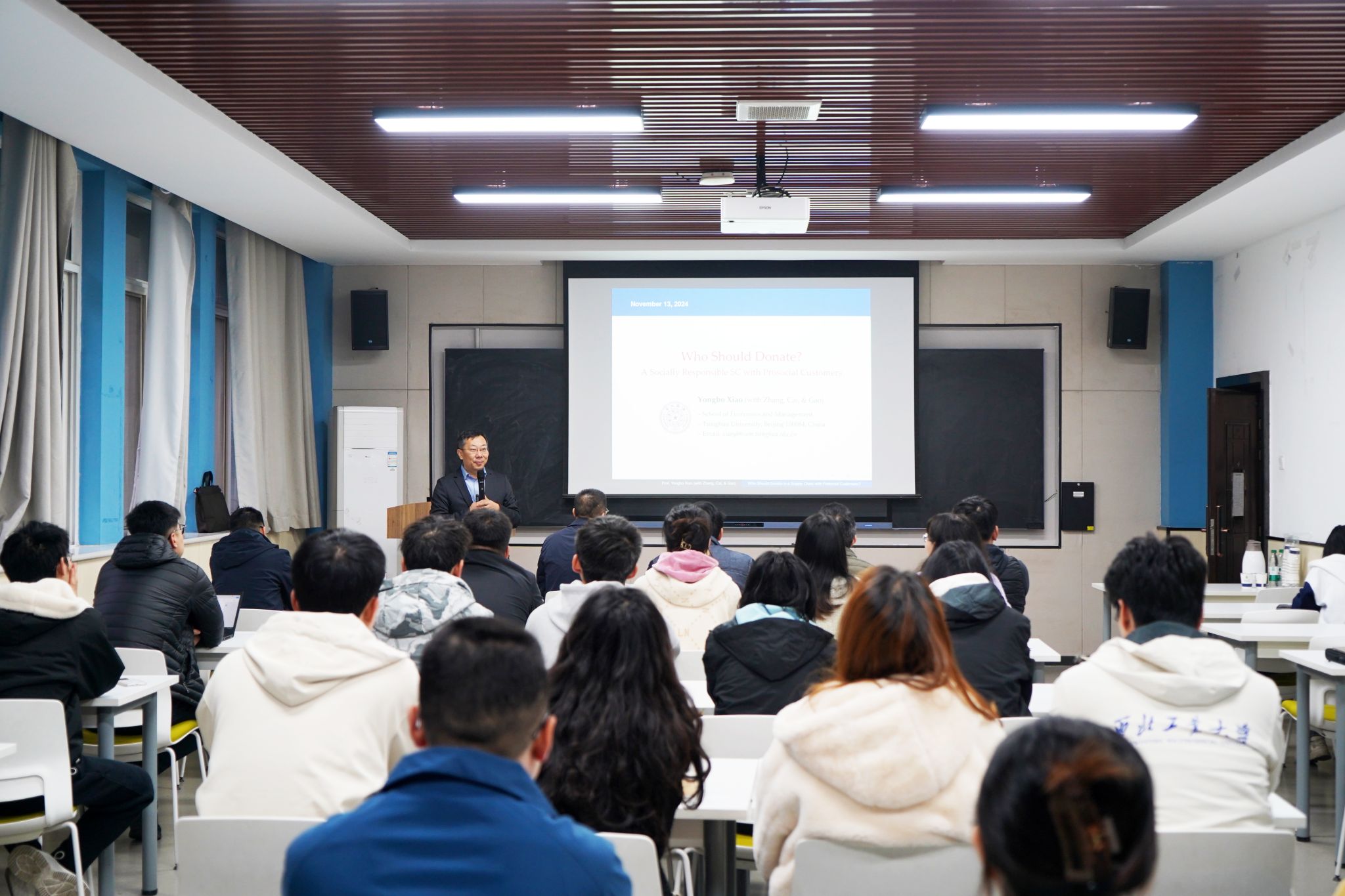
Centering on the theme Who Should Donate? Donation Strategies for Socially Responsible Supply Chains Targeting Prosocial Customers, Professor Xiao presented his latest research findings in a profound yet accessible manner. This lecture not only revealed the shift in corporate responsibilities against the backdrop of the new era, but also explored the core role of donation strategies in supply chain management. At the beginning of the lecture, starting with the transformation of the global business environment, Professor Xiao pointed out that the goals of traditional enterprises have gradually shifted from the single pursuit of profit maximization to diversified objectives that balance social responsibility and social welfare. He particularly emphasized the significant role of Environmental, Social, and Governance (ESG) criteria in the operation of modern enterprises. When discussing the importance of donation behaviors, Professor Xiao cited examples of brands such as ERKE, vividly illustrating the significance and complexity of corporate donation behaviors in supply chain management. Next, drawing on his research background, Professor Xiao conducted an in-depth analysis of the core question—who should donate in the supply chain. Starting from model construction, he introduced how to scientifically design supply chain donation strategies through model solving and property derivation, and revealed the optimal donation strategies for different entities in the supply chain. Finally, Professor Xiao summarized the main conclusions of his research. He pointed out that clarifying the optimal donation strategies for each entity in the supply chain can also achieve a win-win situation between social responsibility and corporate profits. In addition, Professor Xiao put forward the limitations of the research, with a view to further improving the theoretical framework of donation strategies in future research.
During the Q&A session of the academic report, Professor Xiao engaged in a lively discussion with the participating teachers and students, conducting in-depth exchanges on various aspects of the research content. In response to the technical questions about the model raised by the audience, Professor Xiao provided detailed answers. He particularly emphasized that every parameter setting is crucial in model construction and may even exert a significant impact on the research results. Such sensitivity requires researchers to maintain a high degree of prudence and meticulousness in the process of model design and analysis. Professor Xiao further pointed out that when writing and submitting academic papers, researchers can anticipate the potential questions and opinions of reviewers and make adequate preparations, so as to enhance the persuasiveness and rigor of the research. After the meeting, many participating teachers and students stated that through this discussion, they not only deepened their understanding of complex model construction, but also recognized the importance of detailed control in academic research. This exchange provided valuable guidance and inspiration for everyone's future research work, benefiting them greatly.
Speaker ProfileXiao Yongbo is a Tenured Full Professor in the Department of Management Science and Engineering, School of Economics and Management, Tsinghua University. He obtained his Bachelor’s degree in Management Information Systems from Tsinghua University in 2000, and his Master’s and Doctoral degrees in Management Science and Engineering from Tsinghua University in 2006. He completed his postdoctoral research in Applied Economics at the School of Economics and Management, Tsinghua University from 2006 to 2008. He serves as an Associate Editor of the international academic journal
Naval Research Logistics and an Executive Editor of
Journal of Systems Science and Systems Engineering. He also acts as a member of the editorial board of several domestic journals, including
Chinese Journal of Management Science,
Systems Engineering — Theory & Practice, and
Journal of Systems & Management. He is a recipient of the National Science Fund for Distinguished Young Scholars and the National Science Fund for Excellent Young Scholars, and has been selected into the Ministry of Education’s Major Talent Project. He has won research awards such as the China Management Science Youth Award and the Third-Class Beijing Municipal Science and Technology Award. His policy advisory reports have been adopted by the National Committee of the Chinese People's Political Consultative Conference (CPPCC), the Ministry of Education, the United Front Work Department of the CPC Beijing Municipal Committee, the Beijing Municipal Committee of the CPPCC, the Central Committee of the China Association for Promoting Democracy, and Xinhua News Agency. His main research areas include revenue and pricing management, operations and supply chain management, etc. He has presided over a number of National Natural Science Foundation projects (including Youth, General, Key, and Major Projects). His academic papers have been published in international journals such as
Operations Research,
Production and Operations Management,
IIE Transactions,
Decision Sciences, and
Naval Research Logistics, as well as domestic journals including
Systems Engineering — Theory & Practice,
Chinese Journal of Management Science, and
Journal of Management Sciences in China.
Written by/Liu Yuxin Reviewed by/Jia Ming
 CHINESE
 Search