Recently, Professor Fu Chenyi from the School of Management, as the first author, has published online the research paper entitled "Analytics with Robust Epidemiological Compartmental Optimization Models" in Manufacturing & Service Operations Management. His co‑authors include Associate Professor Minglong Zhou from Fudan University, Dr. Zhiyuan Lou from Technical University of Munich, Professor Jingui Xie from Technical University of Munich, Professor Melvyn Sim from National University of Singapore, and Dr. Kelvin Bryan Tan from the Ministry of Health, Singapore. Manufacturing & Service Operations Management is a top‑tier journal in operations management and one of the 24 leading academic journals for business schools (UTD‑24) selected by the University of Texas at Dallas.
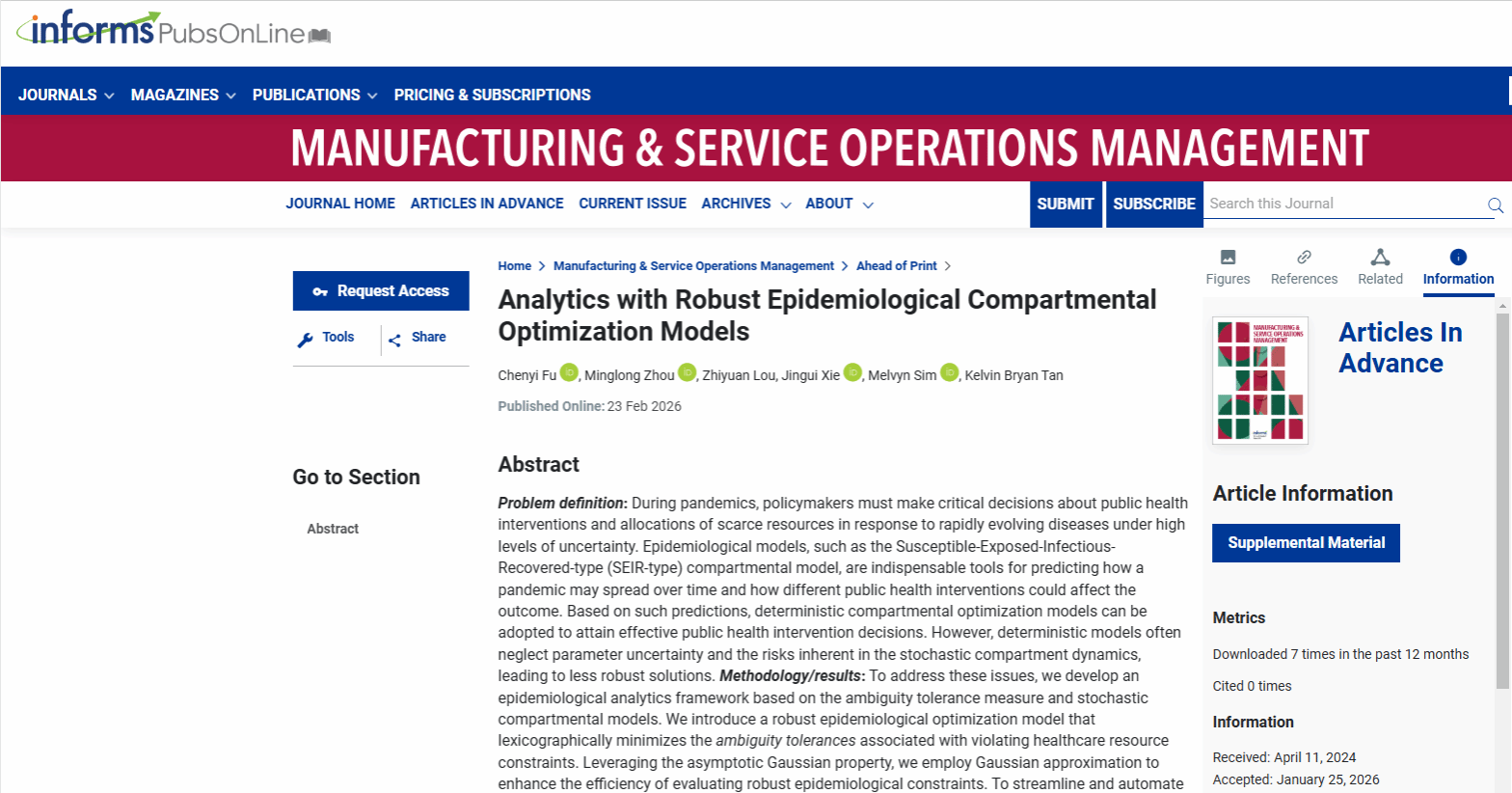
(Link: https://pubsonline.informs.org/doi/10.1287/msom.2024.0984)
This study addresses the reality that policymakers must make critical decisions on public‑health interventions and scarce‑resource allocation amid high uncertainty during pandemics when diseases evolve rapidly. Compartmental models serve as vital tools for forecasting pandemic progression over time and evaluating the impacts of diverse public‑health interventions. Deterministic compartmental optimization models can be adopted to generate effective public‑health intervention decisions based on such forecasts. Nevertheless, deterministic models frequently overlook parameter uncertainty and inherent risks embedded in stochastic compartment dynamics, which yields solutions with insufficient robustness. To tackle these limitations, this research develops a robust epidemiological optimization model built upon ambiguity‑tolerance measures and stochastic compartmental models, which lexicographically minimizes the ambiguity tolerances for violations of healthcare‑resource constraints. Drawing on asymptotic Gaussian properties, Gaussian approximation is applied to boost computational efficiency in evaluating robust epidemiological constraints. To facilitate practical and automated usage for practitioners and policymakers, a Python‑based Robust Epidemiological Analytics Modeling (REALM) toolkit is developed. Using real‑world data from Singapore, multiple resource‑management scenarios are investigated, covering testing capacity, hospital‑bed capacity and vaccine allocation. Numerical experiments demonstrate that under healthcare‑resource capacity constraints, the proposed robust epidemiological analytics model outperforms deterministic benchmark models with respect to metrics such as hospitalized cases and death tolls. The results highlight the value of incorporating risks and ambiguities of disease transmission within epidemiological optimization models.
About the speaker:Fu Chenyi is Professor and Doctoral Supervisor in the Department of Management Science and Engineering, School of Management. His research interests cover robust optimization and urban traffic operation optimization. He has 14 published or accepted journal papers as first or corresponding author, including one paper apiece in three top management‑science journals: Operations Research (UTD‑24), Production and Operations Management (UTD‑24) and Manufacturing & Service Operations Management (UTD‑24). He has published six papers in Transportation Research Part B, a leading journal in transportation operations research, and three papers in European Journal of Operational Research, a high‑level journal for operations optimization. He has received the Best Paper Award and Outstanding Doctoral Dissertation Award from the International Symposium on Computational Transportation Science. He currently presides over one NSFC Young Scientists Fund Project and one Fundamental Research Funds for the Central Universities (Social Sciences) Project.
(Written by:Fu Chenyi Reviewed by:Jia Ming)
 CHINESE
 Search