Recently, Information Systems Research, published by the Institute for Operations Research and the Management Sciences (INFORMS), has published online the latest research by Associate Professor and Doctoral Supervisor Geng Ruibin from the School of Management, Northwestern Polytechnical University, and his collaborators. The paper is titled "Living Up to Online Advice: How Health Platforms Influence Physicians’ Offline Practice". Associate Professor Geng Ruibin serves as the corresponding author. As a top‑ranked international journal in information systems, Information Systems Research is one of the 24 most influential core business‑school journals worldwide (UTD‑24) selected by the University of Texas at Dallas, and also one of the FT‑50 top global business research journals identified by the Financial Times. It enjoys an outstanding international academic reputation in fields including information systems, digital platform governance and technology management. This study focuses on the causal mechanism through which online digital‑health platforms shape physicians’ offline clinical behaviors, providing a systematic theoretical framework and rigorous empirical evidence for understanding the soft‑governance functions of digital platforms.
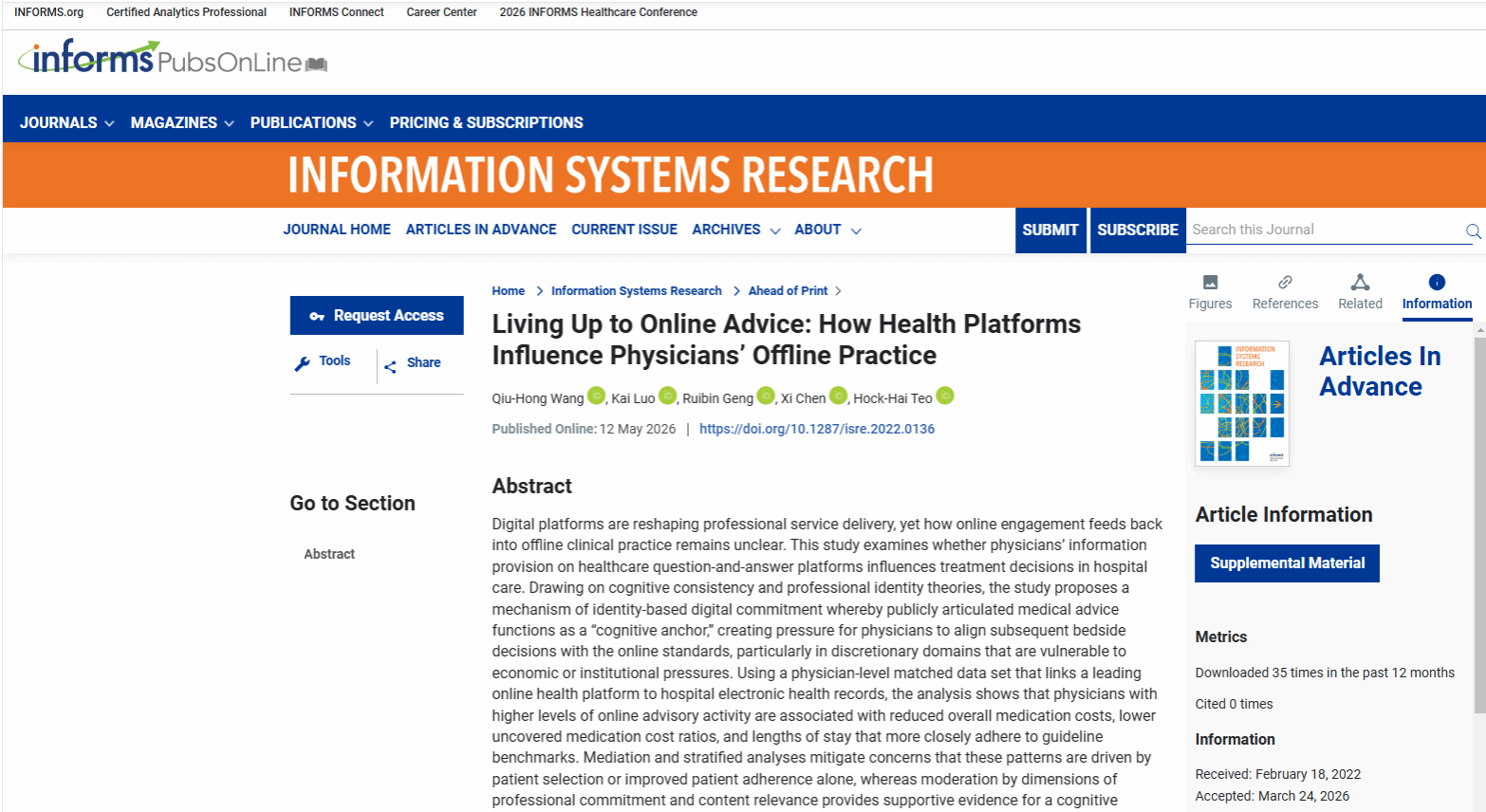
(https://pubsonline.informs.org/doi/abs/10.1287/isre.2022.0136?journalCode=isre)
Over‑treatment and misaligned clinical incentives represent long‑standing problems in healthcare. Existing regulatory instruments mostly rely on external constraints and cannot fundamentally resolve misalignment between physicians’ behaviors and patients’ interests. This study proposes a novel non‑mandatory improvement pathway: physicians’ publicly stated professional positions on online health platforms generate self‑constraining psychological effects on their offline clinical decision‑making, which naturally fosters more standardized diagnosis‑and‑treatment practices without administrative intervention.
To address this core issue, the research team puts forward the theoretical mechanism of Identity‑Based Digital Commitment (IBDC). Integrating cognitive dissonance theory, the commitment‑consistency principle and professional‑identity formation theory, it systematically explains why physicians tend to translate their public online statements into real‑world offline actions. By granting visibility and persistence to such commitments, digital platforms convert professional‑reputation pressure into an endogenous self‑regulation structure.
The empirical results reveal that physicians with higher online‑consultation participation exhibit lower patient out‑of‑pocket drug expenditure ratios and inpatient lengths‑of‑stay more aligned with clinical standards, and such behavioral improvements are not achieved at the cost of medical‑service quality. Further heterogeneity analysis demonstrates that this standardization effect is particularly prominent when patients bear direct medical expenses and when online and offline patient groups largely overlap. These findings offer empirical support for the boundary conditions of the IBDC mechanism.
In terms of academic contributions, this paper proposes and validates the endogenous Identity‑Based Digital Commitment mechanism and uncovers the underlying logic behind the soft‑governance capacity of online platforms — professional conduct can be effectively regulated by endogenous self‑consistency pressure rather than external enforcement. This mechanism is not confined to the healthcare sector; it can be generalized to all professional groups whose public commitments are closely tied to professional identities, such as lawyers, financial consultants and educators. Accordingly, soft governance represents a universally applicable governance form within digital professional contexts. Practically, the conclusions provide vital references for health‑platform mechanism design, optimization of industry regulatory policies, and systematic governance of over‑treatment.
About the speaker:Geng Ruibin is an Associate Professor and Doctoral Supervisor at the School of Management, Northwestern Polytechnical University. His research interests cover digital economy and digital governance, data sharing and information security, and AI‑driven decision‑making analysis. He has published more than 10 papers in leading international journals including Information Systems Research (UTD‑24), INFORMS Journal on Computing (UTD‑24), European Journal of Operational Research, and Information & Management. His publications have accumulated over 1047 SCI citations, with a maximum single‑paper citation count of 655, and one paper has been selected as an ESI Highly Cited Paper. He has presided over more than 10 research projects such as NSFC Youth Project, NSFC General Project and the Youth Fund for Humanities and Social Sciences of the Ministry of Education. His honors include the Third Prize of Outstanding Achievements in Humanities and Social‑Science Research for Shaanxi Provincial Universities (2021), Emerald Outstanding Paper Award (2021), and Nomination for Zhejiang Provincial Excellent Doctoral Dissertation (2017).
(Written by:Discipline & Scientific Research Office Reviewed by:Jia Ming)
 CHINESE
 Search