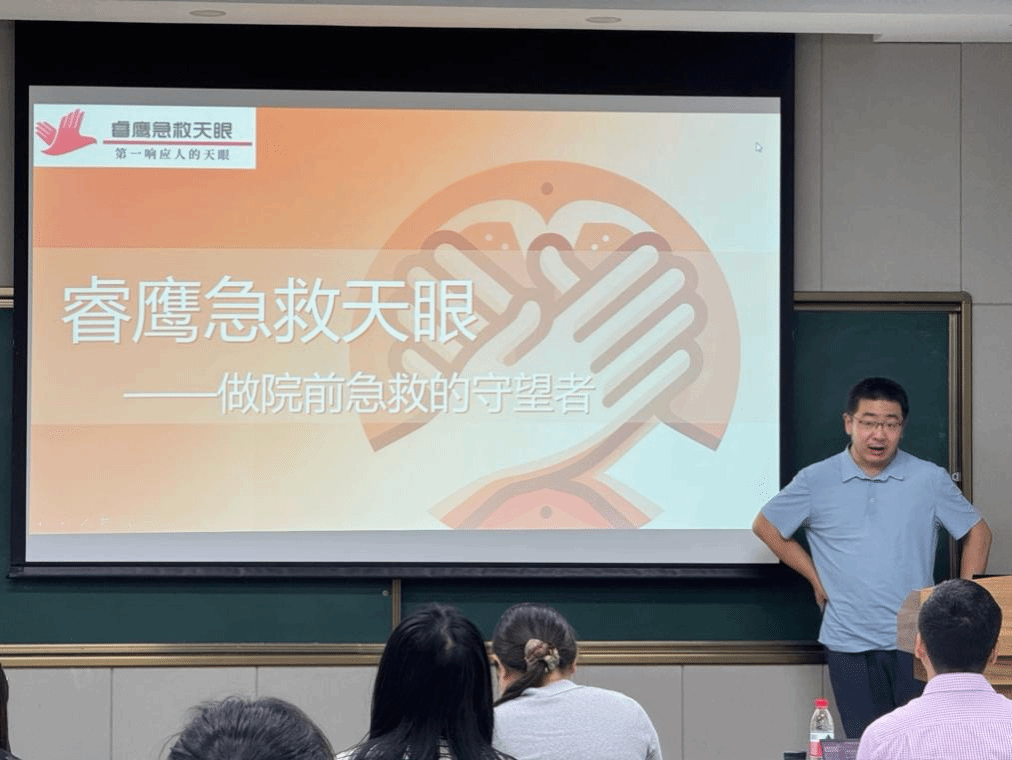
On the afternoon of May 13, Professor Wang Yu from the Southern University of Science and Technology was invited to deliver an academic report entitled "Taking 'Emergency Sky Eye' as an Example: Design, Development, Application and Optimization of Operations Systems Starting from Practical Problems" in Lecture Hall 214, School of Management, Northwestern Polytechnical University. The report was hosted by Associate Professor Wang Peng of the School of Management. Doctoral and master students as well as some faculty members of the School of Management attended the report.
During the report, in response to the practical demand for the "golden four minutes" in pre-hospital emergency care, Professor Wang Yu systematically introduced the research background, technical routes, product functions and application progress of the "Ruiying Emergency Sky Eye" project. Professor Wang pointed out that sudden incidents such as sudden cardiac arrest require extremely fast on-site response. However, ambulances often fail to fully cover the golden treatment window upon arrival. Pre-hospital emergency care still faces challenges including insufficient notification channels, difficulty in identifying potential first responders in a timely manner, and low efficiency in emergency resource scheduling. To tackle these pain points, the project connects patients, callers, nearby qualified volunteer first responders and emergency centers effectively through positioning information, real-time matching algorithms and multi-party video call mechanisms. It realizes functions including display of emergency personnel locations, estimated time of arrival prompts, route guidance, on-site information submission and remote video assisted guidance. Professor Wang focused on the robust optimization algorithm and the "one call, two responses" volunteer dispatch logic in the project. By comprehensively considering the uncertainty of volunteer arrival time, path overlap degree and resource utilization efficiency, the algorithm optimizes multi-responder scheduling schemes and improves the robustness and reliability of pre-hospital emergency response. The report also presented phased achievements of the project in the trial operation at Southern University of Science and Technology, real emergency call cases, marathon event support, cooperation with Shenzhen Emergency Center, embedding into Xiangyang 120 system, and the "human-vehicle-UAV" collaborative emergency pilot in Gulongzhong Scenic Area.
Professor Wang Yu’s report focused on pre-hospital emergency care, an important issue related to people’s livelihood. It integrates scientific inquiry awareness, technological innovation value and practical application orientation. Starting from the emergency demand of the "golden four minutes", the report organically combines robust optimization, intelligent scheduling, mobile internet, volunteer collaboration, linkage with emergency centers and UAV-based AED deployment. It fully demonstrates the transformation path of a smart emergency system from problem identification and model construction to product development and scenario implementation. Especially in volunteer scheduling and the "human-vehicle-UAV" collaborative emergency scheme, the report not only reflects the application potential of operations research and optimization methods in complex public service scenarios, but also shows the practical value of translating scientific research outcomes to support life and health security and the modernization of social governance. The whole report features a clear theme, rigorous logic and vivid cases, with strong practical relevance and enlightening significance. It helps faculty and students further understand key issues in smart healthcare, emergency management and public service optimization, and provides useful references for relevant interdisciplinary research and innovation and entrepreneurship practice.
(Written by:Liu Yuxin Reviewed by:Jia Ming)
About the speaker:Wang Yu received his Bachelor’s degree in Electronic Engineering from the Hong Kong University of Science and Technology and his PhD in Industrial and Systems Engineering from the University of Minnesota, USA. He previously worked as an Assistant Professor at the Lee Kong Chian School of Business, Singapore Management University before returning to China to join the Business School of Southern University of Science and Technology. He is currently a Tenured Professor, with joint appointments in the Department of Statistics, School of Science and the School of Life Sciences. His research focuses on operations management, mainly covering operations system analysis and control, practical-problem-driven operational design and optimization, data-driven research on social operations issues in China, and innovation and development of business operation models. He has published 12 papers in the top UTD business journals. He currently serves as Senior Editor of Production and Operations Management and Associate Editor of Decision Sciences. He was awarded the Third Prize of Zhejiang Provincial Science and Technology Progress Award. His policy advisory report was adopted by the General Office of the State Council, and another policy research report received instructions from the Secretary of Zhejiang Provincial Party Committee. His research and practice projects have been interviewed and reported by CCTV News, People’s Daily, China Youth Daily (front page) and other media. He is selected as Distinguished Young Expert under the National Overseas High-level Talent Introduction Program, Young Top Talent of Guangdong Pearl River Talent Program, and Distinguished Professor of Shenzhen Pengcheng Peacock Program.
 CHINESE
 Search