On August 25, Research Fellow Yang Xiaoguang from the Academy of Mathematics and Systems Science, Chinese Academy of Sciences, was invited to deliver an academic report entitled Understanding of Large Models and Their Attempted Applications in Financial Research in Lecture Hall 210 of the School of Management. The report was hosted by Professor Che Ada, Dean of the School of Management, and attended by some teachers and students of the school.
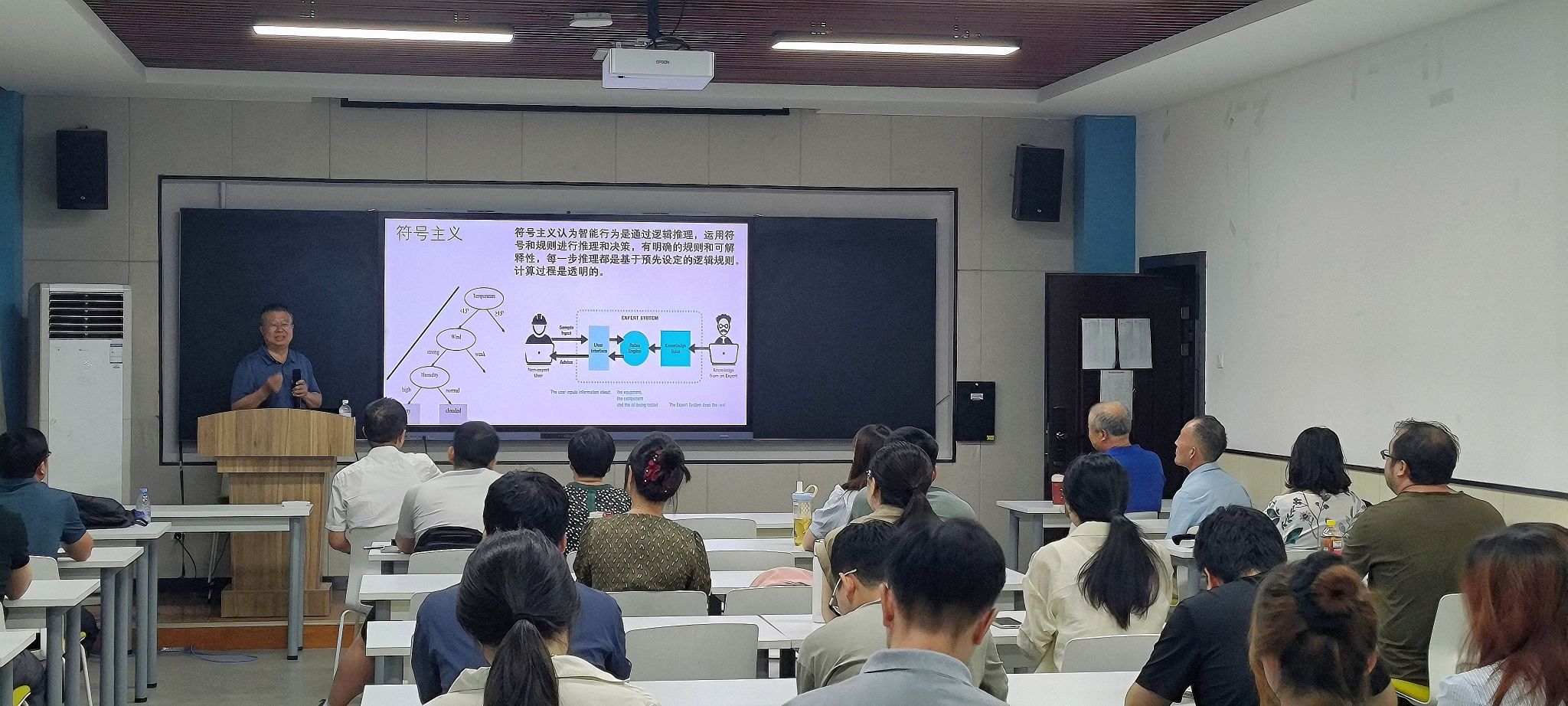
In the report, Research Fellow Yang Xiaoguang first reviewed the three major schools of artificial intelligence development—symbolism, connectionism and behaviorism—and pointed out that current AI technologies represented by large language models (e.g., ChatGPT) are actually the product of the integration of these three schools. He particularly emphasized that connectionism, supported by massive data and computing power, realizes the learning and expression of complex real-world relationships, while symbolism and behaviorism provide interpretability and dynamic interaction capabilities respectively.
In terms of financial applications, Research Fellow Yang Xiaoguang presented a number of empirical studies, including using large models to automatically identify enterprise patents for labor-saving innovation, analyzing the impact of executives' emotions on short-term stock prices during IPO roadshows, and integrating news sentiment analysis with graph neural networks to predict stock market trends.
This report not only demonstrated the broad application prospects of large models in financial research, but also triggered in-depth thinking among the teachers and students present on the transformation of research paradigms in the AI era. The report concluded with warm applause, and the participating teachers and students conducted in-depth exchanges with Research Fellow Yang Xiaoguang on the interpretability, ethical boundaries and future research directions of large models.
Yang Xiaoguang is a Research Fellow at the Academy of Mathematics and Systems Science, Chinese Academy of Sciences, and a Professor at China University of Petroleum (Beijing). He also serves as President of the Systems Engineering Society of China, Vice President of the Euro-Asia Systems Science Society, and Editor-in-Chief of Systems Engineering — Theory & Practice and Journal of Systems Science and Mathematical Sciences. His main research interests include finance, digital economy, game theory, and complex social systems. He has received numerous honors and awards, including the National Excellent Scientific and Technological Worker, Fudan Management Excellence Award, China Youth Science and Technology Award, National Science Fund for Distinguished Young Scholars, Mao Yisheng Youth Science and Technology Award, Expert with Special Government Allowances of the State Council, and being named a National Talent in the Hundred, Thousand and Ten Thousand Talents Project.
Written by/Li Xinyi Reviewed by/Jia Ming
 CHINESE
 Search