On April 2, 2024, at the invitation of the School of Management, Professor Liu Gang from the College of Urban and Environmental Sciences, Peking University conducted academic exchanges with teachers and students of the school in Lecture Hall 214 of the College Building on Chang'an Campus and delivered an academic report entitled Industrial Ecology and Resources & Environmental Management. The report was hosted by Associate Professor Jiang Jijiao and attended by some teachers and graduate students of the School of Management.
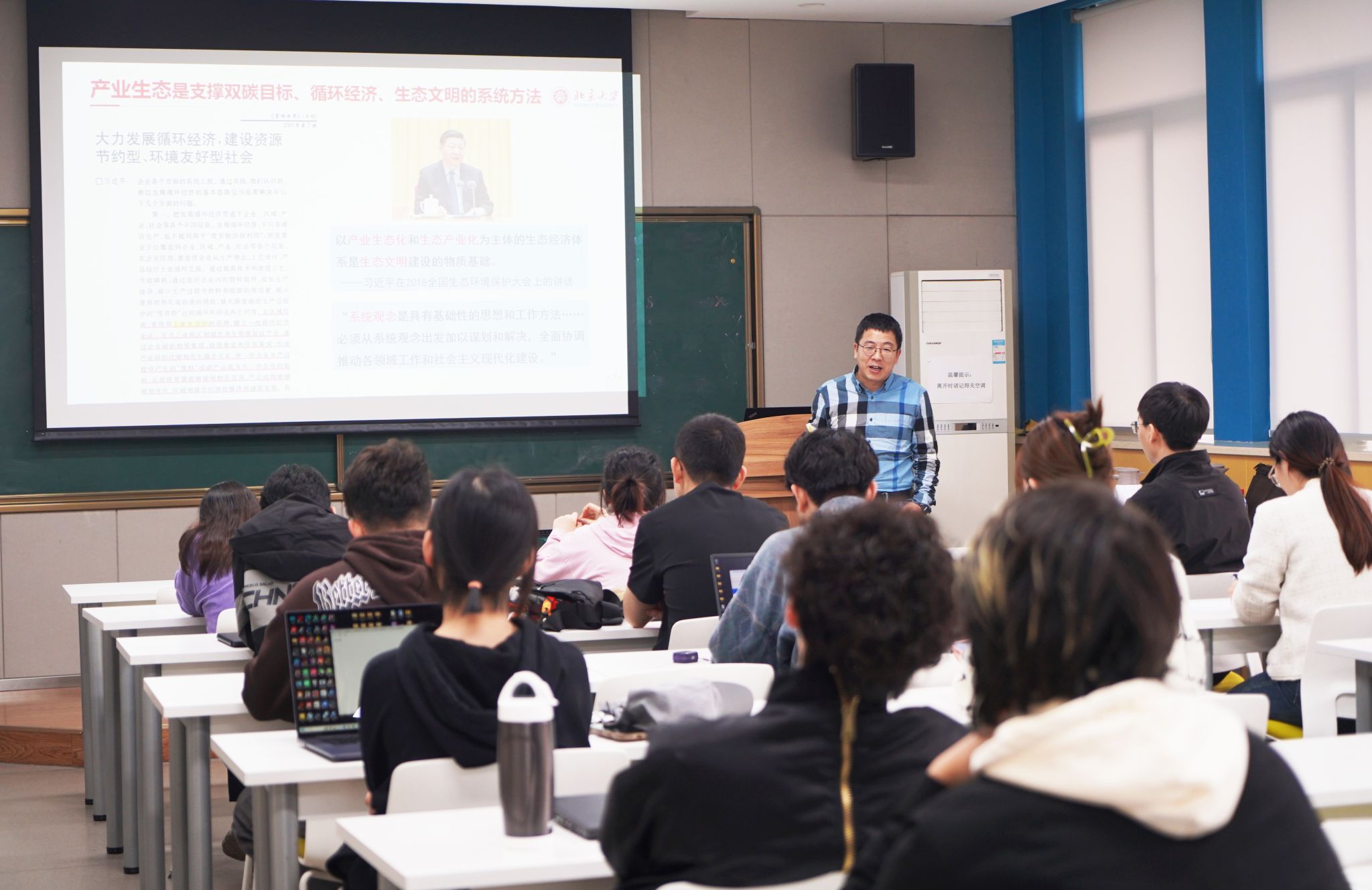
At the beginning of the session, Associate Professor Jiang Jijiao introduced Professor Liu Gang’s research fields, scientific achievements and academic contributions. Subsequently, the teachers and students of the School of Management extended a warm welcome to Professor Liu Gang. In this report, Professor Liu Gang first took the changes in the relationship between social economy and resources & environment as well as the challenges faced by sustainable development as the starting point, and conducted an in-depth analysis of current environmental and social issues. Then, focusing on the growth problem under the constraint of resource and environmental capacity, he introduced industrial ecology from an interdisciplinary perspective. In the final part of the report, Professor Liu Gang discussed the management issues of resources, industry and urban sustainable development in industrial ecology, and made a detailed analysis through specific cases. Professor Liu Gang gradually and in-depth introduced the issues of industrial ecology and resources & environmental management, enabling the participating teachers and students to gain rich academic inspiration.
After the report, Professor Liu Gang had in-depth discussions with the on-site teachers and students on the management of rare earth resources. Finally, Associate Professor Jiang Jijiao summarized this academic exchange and thanked Professor Liu Gang again for his support. This report built a valuable academic exchange platform for the teachers and students of our school, which not only provided practical insights in the field of industrial ecology and resources & environmental management, but also expanded the interdisciplinary research perspective and enriched academic thinking.
Speaker ProfileLiu Gang is currently a Tenured Professor at Peking University, a member of the Ministry of Education’s Major Talent Project, and a Dual-Appointed Professor at the Carbon Neutrality Research Institute. He serves as a Council Member of the International Society for Industrial Ecology (ISIE) and Vice Chair/Secretary-General of its Social-Economic Metabolism Section, a Council Member of the Chinese Society of Natural Resources and Executive Vice Chair/Secretary-General of its Resource Flow and Management Research Professional Committee, Co-Editor-in-Chief of
Journal of Industrial Ecology, and Editorial Board Member of multiple journals in the field of resources and environment such as
Resources, Conservation & Recycling,
Journal of Cleaner Production,
Humanities and Social Sciences Communications,
Scientific Data, and
Bulletin of the Chinese Academy of Sciences. He was awarded the Robert A. Laudise Scientist Award by the International Society for Industrial Ecology "for outstanding contributions to the field of industrial ecology", the Research Frontier Award by the Chinese Society for Industrial Ecology, the James J. Morgan Early Career Award by the top environmental journal
Environmental Science & Technology "for creatively leading new directions in industrial ecology and environmental systems analysis", and the Best Research Award at the World Congress on Digital Built Environment. He has been invited to give keynote speeches at the Gordon Research Conference, Xiangshan Science Conference, Shuangqing Forum, Shanghai Forum, Annual Conference of Danish Geologists, Annual Conference of the Chinese Society of Natural Resources, etc., and has been invited to serve as a consulting expert for international organizations such as the Food and Agriculture Organization of the United Nations (FAO), United Nations Environment Programme (UNEP), World Bank, Organization for Economic Co-operation and Development (OECD), International Energy Agency (IEA), and Joint Research Centre of the European Union (JRC).
Written by/Zhou Cong Reviewed by/Jia Ming
 CHINESE
 Search