On January 9, 2024, at the invitation of the School of Management, Professor Chen Weineng from the School of Computer Science and Engineering and Professor Jiang Huaiguang from the School of Future Technology, South China University of Technology, visited the school for academic exchanges and delivered academic reports respectively entitled Distributed Multi-dimensional Collaborative Swarm Intelligence Evolutionary Optimization Algorithms and Robust State Estimation and Intelligent Scheduling of Multi-energy Systems Under Dual-network Integration. The report session was hosted by Professor Wang Yang and attended by faculty members and graduate students of the School of Management.
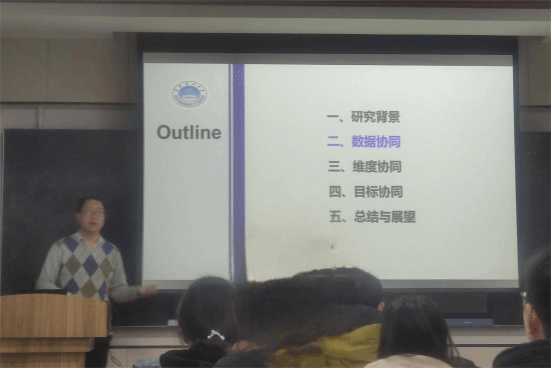
Professor Wang Yang gave a brief introduction to the research backgrounds, directions, scientific achievements and academic contributions of Professors Chen Weineng and Jiang Huaiguang. Professor Chen Weineng first presented the research background and progress of swarm intelligence and swarm intelligence evolutionary computation, as well as the overall framework of distributed multi-dimensional collaborative swarm intelligence evolutionary computation. Next, Professor Chen elaborated on the multi-dimensional collaboration mechanisms of distributed swarm intelligence evolutionary computation from three perspectives, namely dimension collaboration, data collaboration, and objective collaboration. Finally, Professor Chen Weineng provided a detailed introduction to the specific applications of the relevant methods.
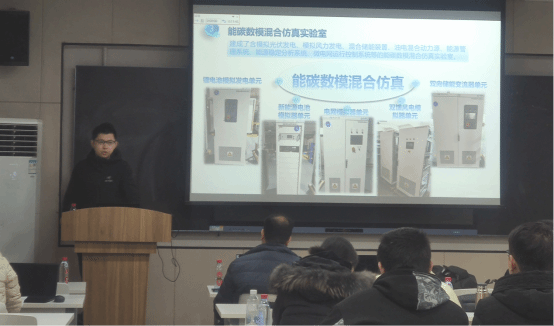
Professor Jiang Huaiguang first outlined the challenges and limitations faced by existing power distribution systems in the new situation. Then, in response to the integration of a large number of electric vehicles, Professor Jiang constructed a coupled network integrating large-scale power distribution systems and transportation systems, and proposed a robust spatiotemporal information learning framework under low observability of the coupled network. This framework can learn the dynamically changing power distribution network topology with limited data and further capture the spatiotemporal correlation of power grid states. Finally, by leveraging the multi-faceted advantages of multi-energy collaborative scheduling in integrated multi-energy systems and the coupled operation of power grids and transportation networks under dual-network coupling, a smart energy network was established with electric vehicles and energy storage as the hubs. Advanced artificial intelligence optimization algorithms were applied to achieve precise scheduling and optimization of energy in the dual networks, real-timely balancing energy supply and demand, promoting complementary energy utilization in urban areas, enhancing the stability and economic efficiency of the dual-network system, improving resource utilization efficiency, and reducing carbon emissions simultaneously.
After the presentations, Professors Chen Weineng and Jiang Huaiguang conducted in-depth exchanges with the on-site teachers and students on topics such as the setting of the number of hyper-heuristic strategies, empirical verification and application of the methods proposed in the reports, as well as the advantages, disadvantages and applicable scenarios of the research methods. Finally, Professor Wang Yang made a brief summary of this academic exchange event. This report session provided an important communication opportunity for the teachers and students of the school to broaden their research horizons.
Chen Weineng is a Professor, Doctoral Supervisor and Vice Dean of the School of Computer Science and Engineering, South China University of Technology. His main research interests include swarm intelligence, evolutionary computation and their applications. He has published more than 100 academic papers in international journals and conferences, among which over 70 are long papers published in IEEE Transactions series. As the chief scientist, he has presided over the National Science and Technology Innovation 2030 – “New Generation Artificial Intelligence” Major Project, as well as more than 10 national and provincial-level projects including the National Key R&D Program International Cooperation Project, Key Support Project of the Joint Fund of the National Natural Science Foundation of China, General Program of the National Natural Science Foundation of China, and Newton Fund Project of the Royal Society of the United Kingdom. He also serves as the director of the Guangdong-Hong Kong Joint Innovation Platform for Big Data and Computational Intelligence. He was granted funding from the National Excellent Young Science Fund in 2016 and the Guangdong Provincial Outstanding Young Science Fund in 2015, and won the Huo Yingdong Young Teacher Award in 2018. His doctoral dissertation has successively received the Outstanding Doctoral Dissertation Award from the IEEE Computational Intelligence Society (CIS) and the Excellent Doctoral Dissertation Award from the China Computer Federation (CCF). Currently, he holds positions including Vice Chair of IEEE Guangzhou Section, Chair of IEEE Systems, Man, and Cybernetics (SMC) Guangzhou Chapter, Member of the Artificial Intelligence and Pattern Recognition Technical Committee and the Collaborative Computing Technical Committee of the China Computer Federation, and Associate Editor of international journals IEEE Transactions on Neural Networks and Learning Systems and Complex and Intelligent Systems.
Jiang Huaiguang is a Professor and Doctoral Supervisor at the School of Future Technology, South China University of Technology, and a recipient of the Overseas High-level Young Talents Program. He has long engaged in research on the intersection of low-carbon smart grids and artificial intelligence technology at the National Renewable Energy Laboratory (NREL) of the United States. He serves as a Standing Member of the Guangzhou Youth Federation and has obtained funding from multiple national-level projects. The Low-Carbon Smart Energy Laboratory led by Professor Jiang focuses on smart grid operation and control, energy big data analysis and application, large-scale new energy grid integration, risk-resistant multi-energy systems and smart energy storage. Based on modern technologies such as artificial intelligence and big data, the laboratory conducts research on power system load forecasting, energy scheduling and intelligent control technologies, providing support for the achievement of the “dual carbon” goals.
Written by/Gao Pengfei Reviewed by/Jia Ming
 CHINESE
 Search